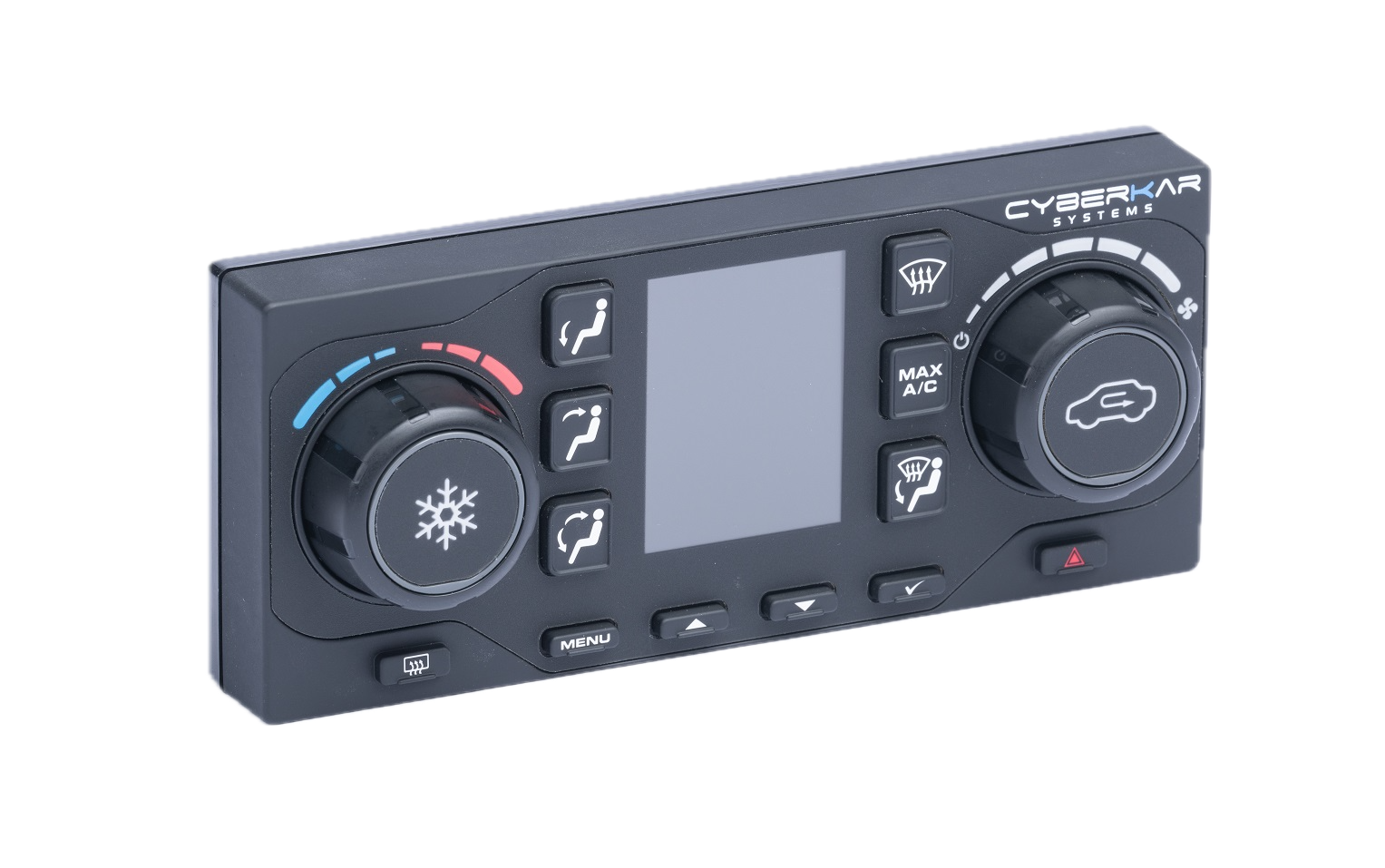




In the ever-evolving world of electronics manufacturing, the functionality of a device is often only as good as its weakest link. For membrane switches and flexible circuits deployed in harsh environments, whether it’s a medical device being continually wiped down with strong disinfectants, an automotive part exposed to gasoline fumes or an aerospace instrument that is subjected to rapid altitude changes, the weakest link they have in common, has traditionally been the adhesive.
For years, Pressure Sensitive Adhesives (PSA) have been the industry standard. While effective for simple applications, PSAs have inherent microscopic flaws that lead to catastrophic failures when pushed to the limit. Enter HeatSeal®, a revolutionary technology that doesn’t just stick layers together, it fuses them. This blog explores why HeatSeal® should be the go-to solution for high-reliability applications and how it solves the critical vulnerabilities of traditional adhesives.
The Micro-Fissure Problem
In order to understand all the benefits of HeatSeal®, we must first understand why traditional Pressure Sensitive Adhesives can fail. Under a microscope, a layer of PSA looks less like a solid wall and more like a sponge. PSAs are “tacky” solids that never achieve 100% wet-out (process of an adhesive flowing to maximize contact area) on a surface. This results in inherent micro-fissures and voids (microscopic air channels that act as potential points of failure.)
These voids create a phenomenon known as capillary action. Like how a paper towel wicks up water, these micro-fissures draw in liquids, cleaners, and chemicals. Over time, this ingress dissolves the bond and attacks the sensitive silver circuitry underneath, leading to electrical shorts and system failure. Furthermore, these air gaps provide low-resistance paths for Electrostatic Discharge (ESD), putting delicate electronic components at risk.
The Power of Thermal Fusion
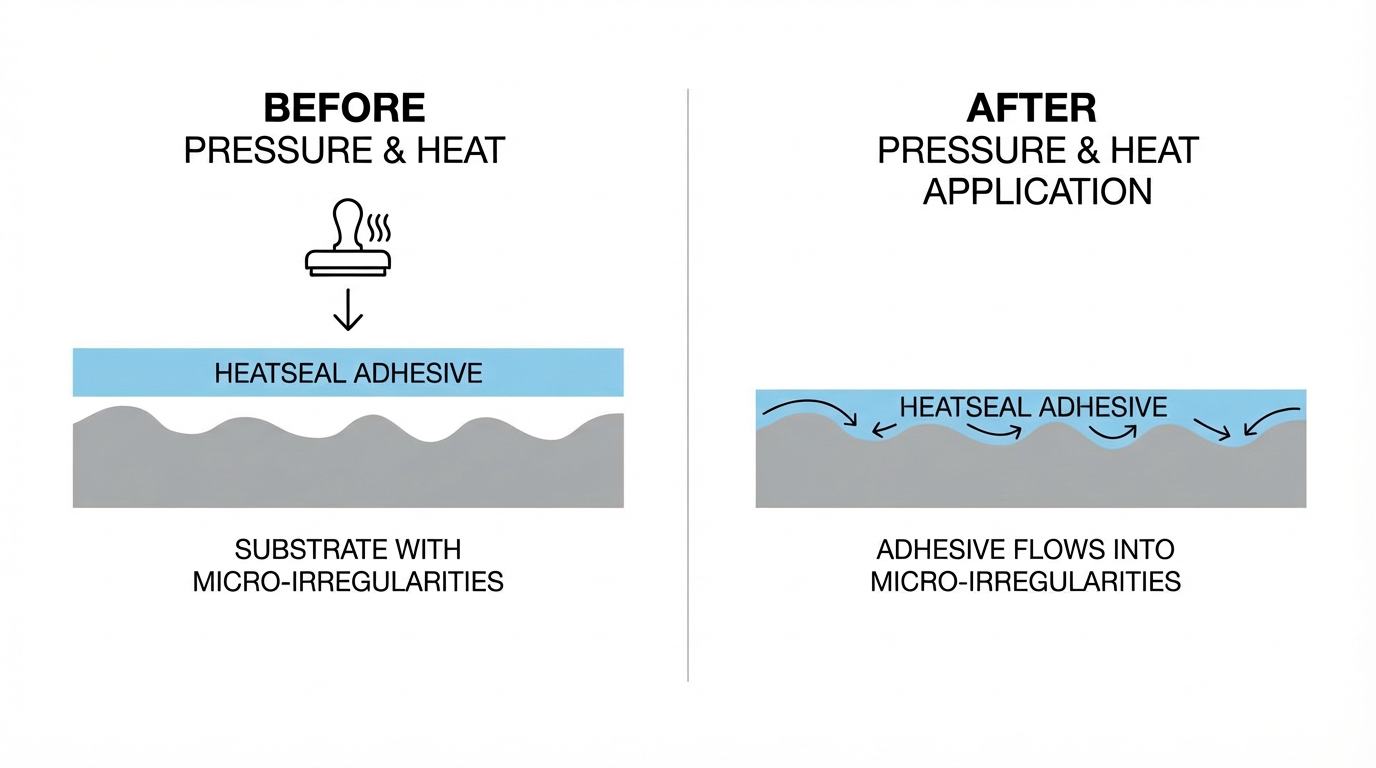
HeatSeal® fundamentally changes bonding through a process called thermal fusion. Unlike PSAs, which rely on surface tack, HeatSeal® is a proprietary adhesive that transitions to its final state under controlled heat and pressure. During this phase change, the adhesive flows into every microscopic surface irregularity, completely wetting out the substrate. The result is a solid, fissure-free barrier that is chemically and physically fused to the carrier. This eliminates the capillary pathways that plague PSAs, creating a true hermetic seal. It is not merely a glue; it is a structural integration of the switch layers.
Unmatched Chemical Resistance
One of the most significant advantages of HeatSeal® is its resistance to chemicals. In comparative testing, the difference are clear:
- Household Cleaners: Standard PSAs exposed to common cleaners like 409®, Fantastik®, or bleach often fail within 20 to 40 days due to adhesive dissolution and fluid ingress. In contrast, HeatSeal® switches have withstood over 180 days of continuous immersion with zero degradation.
- Hydrocarbons and Solvents: Exposure to gasoline causes PSAs to dissolve and delaminate within hours. HeatSeal® maintains 100% insulation resistance and structural integrity even after 14 days of full immersion.
- Modern Contaminants: Everyday substances like sunscreen and insect repellent (DEET) are surprisingly destructive to plastics and adhesives. HeatSeal® is specifically engineered to resist these modern chemical stressors, passing rigorous automotive standards (GMW14445) where standard adhesives fail after a single cycle.
Thriving Under Pressure (and Altitude)
For devices used in aerospace or high-altitude environments, air pressure differentials are a silent killer. As a device ascends to 40,000 feet, the air trapped inside a switch expands. With PSAs, this air forces its way out through the micro-fissures. The problem arises upon descent: the switch cannot “re-inhale” quickly enough, creating a vacuum that sucks the switch layers together, causing permanent collapse and electrical shorts.
HeatSeal® prevents this “bends” phenomenon. Its hermetic bond prevents air expulsion in the first place. While the switch may bulge slightly at high altitudes, the bond holds firm, and the switch returns perfectly to its neutral state upon return to normal pressure. This capability has been validated in medical and aerospace applications from 100 to 40,000 feet.
Additionally, the mechanical strength of the bond is immense. While industry specifications typically require a switch to withstand 7.5 PSI of internal pressure, we exceed this limit with our HeatSeal® adhesive to an average limit of 35 PSI internal pressure during testing. can assemblies average a burst pressure of 60 PSI—an 8x safety margin that ensures IP67 and IP68 ingress ratings are easily achievable.
Superior Thermal Stability
Temperature fluctuations are the enemy of adhesion. Standard PSAs exhibit a non-linear bond strength that degrades rapidly as temperatures rise. At 100°C, the peel strength of a PSA can drop by over 90%, leaving the assembly vulnerable to delamination caused by the expansion and contraction of different materials.
HeatSeal® maintains a stable bond profile across a massive operating range of -25°C to 100°C. At the 100°C mark HeatSeal® retains above 2.0 lbs/in² of peel strength. This thermal stability ensures that the switch remains intact and functional even in the sweltering heat of an engine bay or an industrial sterilization chamber.
Built-in ESD Protection
Finally, HeatSeal® offers a hidden electrical benefit. Because it eliminates air voids and is composed of high-dielectric polyester resin, the adhesive layer itself acts as a powerful insulator against Electrostatic Discharge (ESD). PSA based switches often require expensive secondary shielding layers, such as printed silver grids, to protect sensitive circuitry from static shocks that travel through the adhesive’s micro-fissures. HeatSeal® inherently provides a minimum of 15kV (and up to 25kV) of dielectric protection, effectively sealing the conductive traces. This not only improves reliability but can also reduce manufacturing costs by eliminating the need for additional shielding components.
Conclusion
In the world of industrial, medical, automotive and aerospace electronics, the cost of failure is too high to leave things to chance. HeatSeal® represents a shift from simple adhesion to structural fusion. By eliminating the microscopic vulnerabilities of PSAs in high demand use cases, HeatSeal® offers a robust, hermetic, and chemically resistant solution that stands up to the most extreme environments.
For engineers and designers looking to future-proof their devices against water, chemicals, heat, and pressure, HeatSeal® is not just an alternative, it is the next phase in the evolution of adhesive technology. For more information please contact us.